

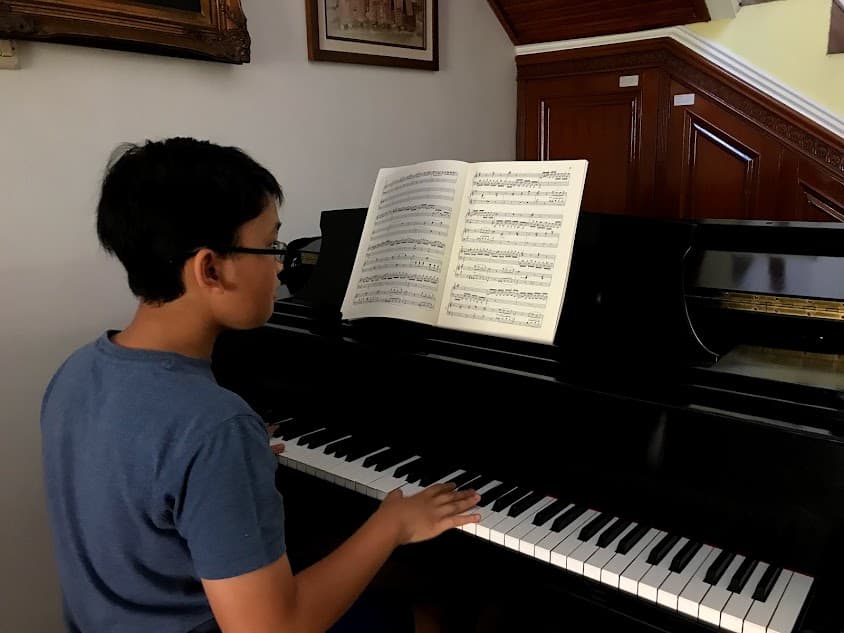
How Progress Happens in Piano Lessons and Practices (Part 1)
15/10/2026
How Progress Happens in Piano Lessons and Practices (Part 1)
For beginners, progress at the piano rarely appears after the first lesson. It usually happens in small, sometimes in unexpected moments: a difficult measure becomes easier, a rhythm becomes steadier, or a student plays a passage with more confidence than they did last week. Structured piano lessons matter because they give students a healthy mindset to turn “I can’t do it.” into “I know how to practice my stuff.” Progress begins with a clear goal Effective practice starts with a specific question, not a general instruction. When the teacher says, “Practice the piece” can feel overwhelming; but if he or she says, “Can you play the first four measures hands separately with steady counting?” gives the student something concrete to accomplish. A useful weekly lesson goal might be: • Play the left-hand part slowly without stopping. • Count the rhythm out loud through one short phrase. • Play a difficult measure three times in a row without mistakes. • Add the right hand only after each hand feels secure. This approach helps students see that progress is not simply “playing through” a piece. It is learning to identify what needs attention and choosing a manageable way to work on it. Piano teachers often break a piece into small sections, focusing on difficult passages. Progress would be obtained by slow, attentive repetition rather than asking students to repeat an entire piece from beginning to end. Small sections make challenges manageable When a beginner encounters a difficult passage in a repertoire, the solution is usually not to play the whole song again and hope it improves. It is to make the task smaller. For example, if a student struggles with a four-measure phrase, the teacher might isolate two measures, then one measure, then even the transition between two chords. The student practices the left hand, then the right hand, and finally combines them at a slow tempo. Only after the passage is secure does the tempo gradually increase. This process teaches an important lesson: a challenge can be broken into steps. The student does not need to solve everything at once. They only need to take the next useful step. Listening turns repetition into learning Repetition in piano practice is very important, but repetition alone does not guarantee improvement. A student can play the same passage ten times and repeat the same mistake ten times. Progress happens when the student listens with intention: • What did I hear? • What went well? • What needs to change? • What will I try differently next time? Feedback is what transforms repetition into improvement. After playing a passage, students can evaluate whether the rhythm was steady, whether the notes were accurate, or whether the hands moved smoothly together. In a lesson, the teacher helps make this listening more precise. Instead of saying only, “That was better,” a teacher might say, “Your rhythm was steady; now let’s keep your left hand relaxed during the leap.” The student receives both encouragement and a clear next action. -Alfred Situmorang- October 2026


